How could the farm prudently utilize LED lighting?
It is undoubtedly novel and innovative to employ LED lighting in chicken farms for breeding purposes. But first, we need to understand how to use LED lighting in henhouses. There is a lot of information in this, and it will be covered in detail in this essay.
It should be noted that the poultry farming business is often highly conservative, therefore adoption of LED technology must take some time. But, the LED technology and its energy-saving advantages have now been fully accepted by the poultry farming business. The lighting requirements of the poultry farming business have steadily been satisfied over the past few years by more advanced LED technology.
Better LED lamps than incandescent ones can save between 80% and 85% of their energy. Nevertheless, not every LED light is the same. Before making a purchase, professionals in the aquaculture sector should do some study on LED lights. You don't want to make errors and waste silver because LED lighting are more expensive overall than incandescent lamps.
Lighting has a significant role in the environment for those who raise poultry. Growth rate, animal welfare, and production efficiency are all impacted by lighting. The four main components of light are spectral range, source, period, and intensity. The many wavelengths in the visible spectrum affect the color of light.
Field test of LEDs
Thankfully, when LED first entered the chicken sector, several renowned colleges in the United States, including Mississippi State University, Auburn University, University of Georgia, University of Arkansas, University of Maryland, University of Delaware, etc. the exam. These promoters have assessed a range of various LED goods after conducting several field tests, and they have offered reasonable assessment findings about the cost analysis, possibility for investment return, and product lifespan. Please feel free to request and thoroughly examine these assessment findings as they are offered without charge to assist you in making the best buying choice.
Please don't select LED lights that haven't been tested in a real-world setting, like a chicken coop. The atmosphere in chicken coops is more harsher than that in homes and places of business because of the effect of ammonia, dust, and humidity. Some light bulbs cannot withstand these conditions or are not intended for such environments.
LEDs provide perfect energy-saving performance. Farmers are curious in LEDs and wonder if chicken performance will be comparable to that of incandescent lighting.
The answer is yes, but only if the hatching and developing process is carried out in an environment with adequate lighting, a functional dimmer, and well-cared-for chickens. In this manner, poultry will perform just as well under LED lighting as it would under any other.
How does LED impact chickens?
Several farmers have discovered that the disposition of the poultry has improved after making the move from compact fluorescent lights to LED lights. Perhaps this is due to the fact that LED lights do not flicker like fluorescent ones. Chickens are more sensitive to flashing lights than humans because they have superior eyesight.
Certain dimmers cannot be converted to work with LED lights since LED technology is somewhat more advanced than dimmer technology. As a result, LED bulbs cannot be dimmed linearly like incandescent lights (the so-called linear dimming method reduces the brightness of the bulb by 20% when the dimmer is turned down). To make an LED light exhibit a slight dimming, the dimmer may need to be changed extremely dramatically. The production of dimmers is likewise lagging behind, but there are still a lot of outdated dimmers on the market that need to be replaced in order to precisely control the LED lights' brightness.
Some dimmers may simply require the installation of an update chip to function correctly, whilst others are too old and must be replaced with new items in order to be compatible with more sophisticated LED technology.
Choose LED lights with the proper color temperature. Kelvin temperature units are used to express the color temperature (Kelvin). Warm light has an orange-red tint and ranges in temperature from 2700 to 3000K, similar to incandescent or high-pressure sodium light. The Kelvin scale measures temperatures from 3400 to 3700. The cold light is bluish-white in hue and has a Kelvin temperature between 5000 and 6000.
Nowadays, breeder chicken breeding uses LED lights with a color temperature of 2700, whereas broiler chicken breeding uses lights with a color temperature of 5000 Kelvin. Once more, not every LED light is appropriate for breeding. For chicken coops, a high-quality omnidirectional home LED light is not the best option.
A little over 40% of omnidirectional LED lights may illuminate the walls and roof, which may be useful for homes but impractical for chicken coops as the majority of the lights in a coop must beam straight on the ground.
To suit the demands of hens, it could be essential to buy high-wattage LED lights. These lights cost more than LED lights with lower power. Omnidirectional LED lights make up the majority of the lights available at hardware or bargain stores.
Be sure the LED bulbs you choose are what you need because they are more expensive than incandescent lamps, even the cheapest ones. You must comprehend the luminous flux unit and the significance of the readings being used. An illuminance meter may be brought to the chicken coop by your after-sales professional to measure the lighting effects there right away.
A metric of light intensity called a foot-candle can be used to compare the brightness of various light sources. A lumen falling on a one square foot area is equal to one footcandle. A lumen is the amount of total output light that one candle can emit at a solid angle, which reflects brightness. For instance, a 10W 19A non-dimmable LED bulb may have 900 lumens of brightness, whereas a 6W 19A dimmable LED bulb would have 530 lumens.
For the first 4–14 days after birth, chicks often need 2 foot candles or more, depending on the breed and diet. To maintain the flock's healthy growth, the light must be reduced to a very low level (0.03 foot candles or less) in the following time. The secret to keeping chickens in good condition is using the right light intensity. Try not to illuminate the wall with the light, which needs to be considerably higher than the feeding trough. The consistent lighting of the chicken house is very important, and there should not be too dark or too bright locations.
To prevent black patches and lessen the range of excessive brightness, LED producers are always upgrading their procedures. Correct lighting angles can assist focus light on chickens and cut down on light that is wasted on the walls and ceilings.
How well does LED work in an agricultural setting?
There have been recent attempts to adapt LED lights to young hens and broiler breeders, although most LED lights are utilized for broiler chicks. According to preliminary findings, the latter two birds have an impact that is comparable to that of broilers.
In its four chicken coops, a broiler farm in Mississippi switched to LED lighting a year ago from high-pressure sodium lighting. This action reduces monthly electricity costs by $1,500.
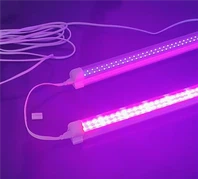
Under LED lighting, hens' productivity indices are identical to those under high pressure sodium lighting. 10 watts of 2700 open, 19 amp, non-dimmable LED lights are used on this farm. There are two light strips put above the chicken coop and two light strips above the split in the center of the chicken coop, each measuring ten feet in length. Once again, breeders of young hens and breeders often use 2700 kw LED lights, whereas breeders of broilers typically use 5000 kw LED lights.
Yet, a recent research by the U.S. Department of Agriculture found that under three distinct LED light sources, broiler chicken weight rose (one brand of 2700-on light bulbs and the other two brands of 5,000-on light bulbs). There is no distinction between the blood physiological markers and those of broilers. This would mean that in industrial poultry farming, these three different kinds of LED light sources can take the place of incandescent lights, lowering energy use and increasing production efficiency without altering physiological markers.
Producers are encouraged to switch over to energy-efficient LED bulbs in the United States and Canada thanks to the federal government's environmental quality incentive program and the local government's conservation program. These initiatives may be utilized to get the appropriate incentives.
Nonetheless, the waiting list is often quite long. After signing up, you must wait a very long period before getting your turn. To be eligible for the conservation plan, a farm energy audit report could be necessary, which would incur additional costs. As a result, rather than waiting for assistance from the savings plan, an increasing number of farmers decide to change the light bulbs on their own, instantly saving money on power bills.
In the long term, it is a smart decision to buy your own bulbs and switch to LED lights even if you decide not to join the savings scheme. The cost of the LED lights may be recovered from the reduced power costs within a year. Also, the majority of LED lights have a guarantee that lasts at least three years, and some companies even provide warranties that last up to five years.
Last but not least, I urge you to study and compare prices before making a purchase. All LED lights, regardless of price, will significantly reduce power costs. Choose LED lights with practical expertise in agricultural settings (such as chicken houses).


Choosing us, choosing lamps with high efficiency and perfect lighting effect, Benwei is better professional and guaranteed. If you have more questions or needs, please send an email to bwzm18@benweilighting.com. We will reply you within 24 hours.